16 Sep 2026
Direct Composite and Rubber Dam: A Three-Day Hands-On Course with Dr. Vishal Gupta
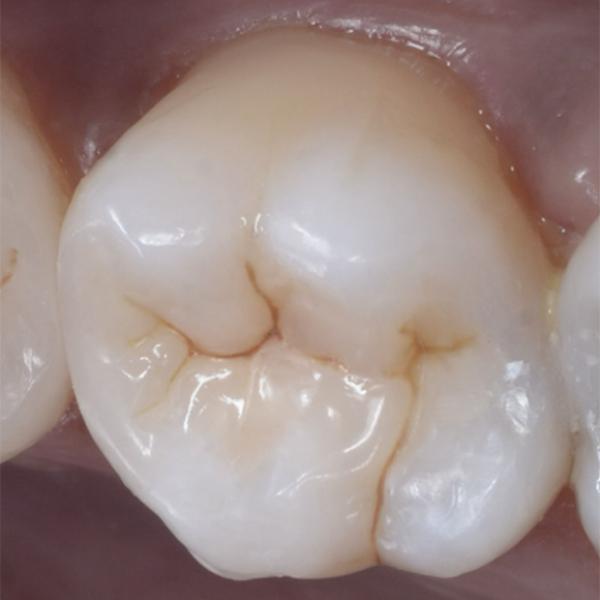
If you walk into ten dental clinics across India and watch ten dentists place a posterior composite, you will see ten different workflows. Some will isolate with cotton rolls. A few will reach for a rubber dam, fumble with the clamp, and abandon it after the third unsuccessful try. One or two will place it confidently in under three minutes. The restorations that follow will vary just as widely, in marginal adaptation, in proximal contact tightness, in shade match, in polish, and ultimately in how long they survive in the mouth before they need to be replaced.
This variation is not because composite is a difficult material. It is because composite is a technique-sensitive material, and the technique is rarely taught well at the undergraduate level. The Direct Composite and Rubber Dam hands-on course at Acharya Foundation, mentored by Dr. Vishal Gupta, was built to fix that gap in three intensive days.
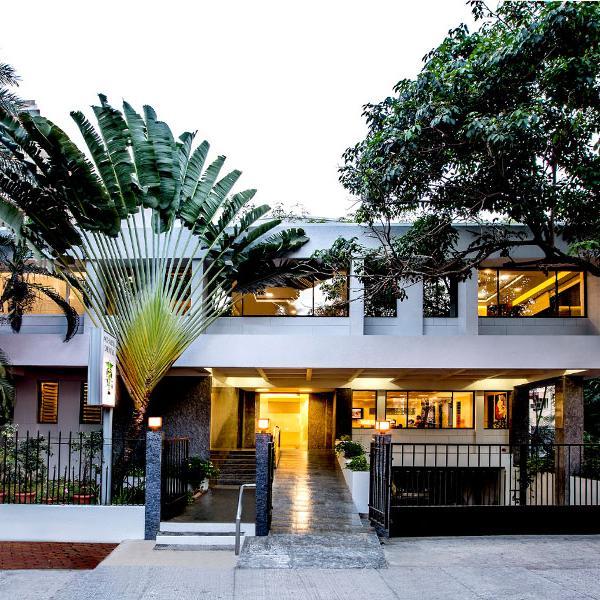
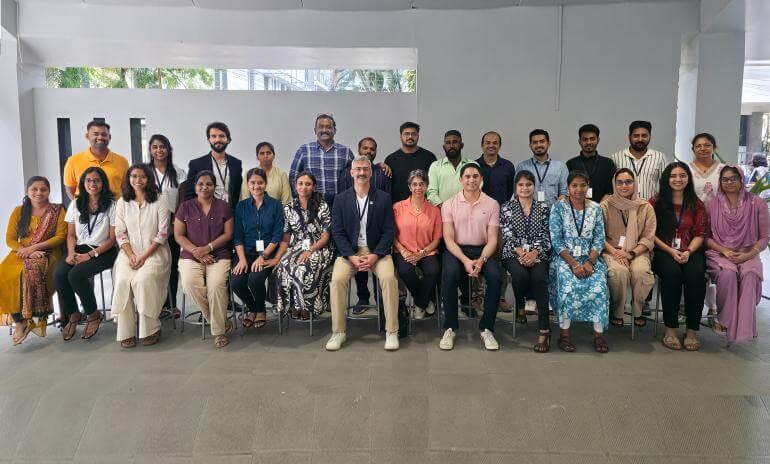
The course is taught in batches at the foundation's Nungambakkam campus in Chennai. The format is a three-day intensive that combines clinical lectures with extensive hands-on simulation work. Past batches have filled rapidly and run with twenty-five participants, with seats reserved for serious clinicians from across India. Past editions, including the October 2025 batch, have run as sponsored or no-fee programmes, with future editions priced through the course page as the calendar updates.
Why Composite Is the Most Important Restorative Skill in Modern General Practice
Amalgam has all but disappeared from urban Indian practices. Patients ask for tooth-coloured restorations even on second molars. Insurance trends and aesthetic expectations have made composite the default direct restorative material across most general dental practices. The clinician who places ten direct composites a week, well, with predictable contacts and margins and long-term durability, is the clinician whose practice runs smoothly.
The clinician whose composites need replacement every two or three years, who fights chronic post-operative sensitivity, who battles open contacts and shade mismatches, is the clinician whose chair time fills up with re-restoration appointments that never quite generate fresh revenue. Composite is the single highest-volume restorative procedure in modern practice. Getting it right is not a niche skill. It is the centre of the workflow.
Rubber dam is the gateway to that workflow. Every published meta-analysis on direct composite restorations identifies isolation as the single largest determinant of long-term success. A dry, well-isolated field changes bonding outcomes, changes restoration longevity, and changes the relationship between effort spent and result achieved. A clinician who can place a rubber dam in three minutes flat, on any tooth in the mouth, has access to a level of restorative quality that is simply not available without isolation.
Why Dr. Vishal Gupta
Dr. Vishal Gupta is one of India's most respected hands-on educators in restorative dentistry. His teaching style is built around demonstrated technique, immediate hands-on practice, and the kind of small-detail corrections that come from watching thousands of clinicians place rubber dams and composites and noticing the specific points where each one struggles.
He teaches both the standalone one-day Rubber Dam course and the three-day Direct Composite and Rubber Dam intensive at Acharya Foundation. The three-day intensive is the deeper version, built for clinicians who want to systematically rework their entire restorative workflow rather than just add a single skill to their existing practice.
His clinical photographs, lectures, and educational content have shaped how a generation of Indian dentists thinks about adhesive dentistry. The course at Acharya Foundation gives participants direct access to that experience over three days, in the simulation lab, with personal feedback on every exercise.
The Three-Day Structure
The course is built around two intertwined themes. Rubber dam isolation across every clinical scenario a general dentist will encounter, and direct composite restorations for both posterior and anterior teeth. The two themes are taught together rather than separately because they are, in clinical reality, two sides of the same workflow.
Day one opens with the philosophy and rationale behind isolation. Why rubber dams matter. The evidence base. The patient communication script that turns isolation from an obstacle into an accepted part of the appointment. The equipment overview, including dam materials, frames, clamp selection, punch sizing, and the small accessories that make the difference between a struggle and a routine three-minute placement.
The morning then moves into the foundational rubber dam techniques. Single tooth isolation. Quadrant isolation. The split dam technique for situations where a clamp cannot be placed. Anterior isolation for aesthetic work. The afternoon walks through challenging clinical scenarios. Deep subgingival margins. Fractured teeth where there is little supragingival tooth structure to anchor the clamp. Heavily restored teeth. Teeth in severe rotation. Cases where the dam needs to be modified mid-procedure to access a new working area.
Day two moves into direct composite restorations on posterior teeth. The morning covers cavity design philosophy for adhesive restorations, the principles of selective enamel etching and total etch protocols, the modern simplified bonding workflow, and the choice between universal adhesives and traditional multi-step systems. The afternoon is hands-on. Participants prepare and restore Class II cavities on phantom models, walking through matrix selection, sectional matrix systems for tight proximal contacts, wedging technique, contact creation, layering technique, shade selection for posterior composites, and the finishing and polishing sequence that produces a restoration that mimics enamel.
Day three covers anterior direct composites. The aesthetic challenges around shade selection, the layering technique that recreates dentine and enamel optical properties, free-hand composite versus silicone matrix-guided approaches, polishing protocols that produce a high-gloss surface, and the specific tricks that produce predictable Class IV restorations on fractured incisors. The hands-on work includes complete anterior build-ups on phantom teeth, with feedback on shade, contour, and finish from Dr. Vishal Gupta directly.
The full three days are spent moving between the seminar room and the simulation lab. The teaching philosophy is that no lecture should run for more than ninety minutes without being followed by a hands-on exercise that puts the lecture into the hands of the participant. Skills built this way travel back to the practice in a way that lectures alone never do.
The Rubber Dam Curriculum in Detail
Rubber dam placement is the single skill most undertaught at the BDS level. The course treats it as a discrete craft worth several hours of dedicated practice, rather than as an afterthought to the restorative work itself.
Equipment selection is the first lesson. The choice between heavy and medium dam, the colour choice that suits the photography style of the practice, the frame selection between metal and plastic, the punch and its hole sizing for different teeth, and the clamp library that every clinician should build, with named clamps for specific anatomical situations.
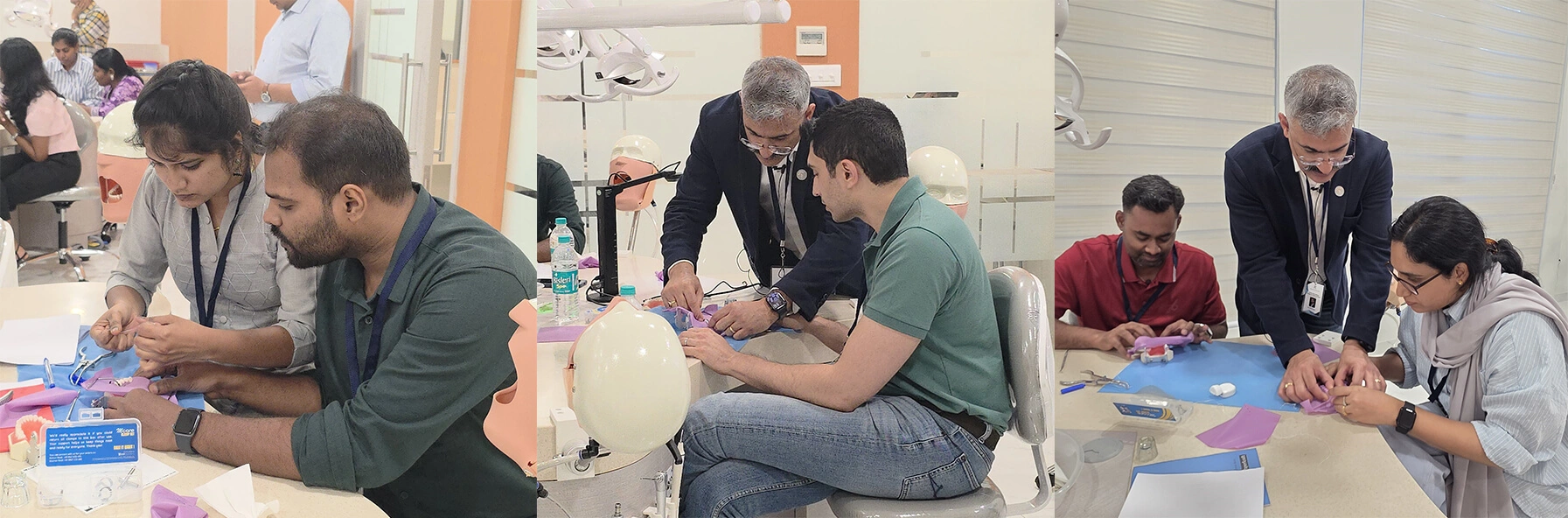
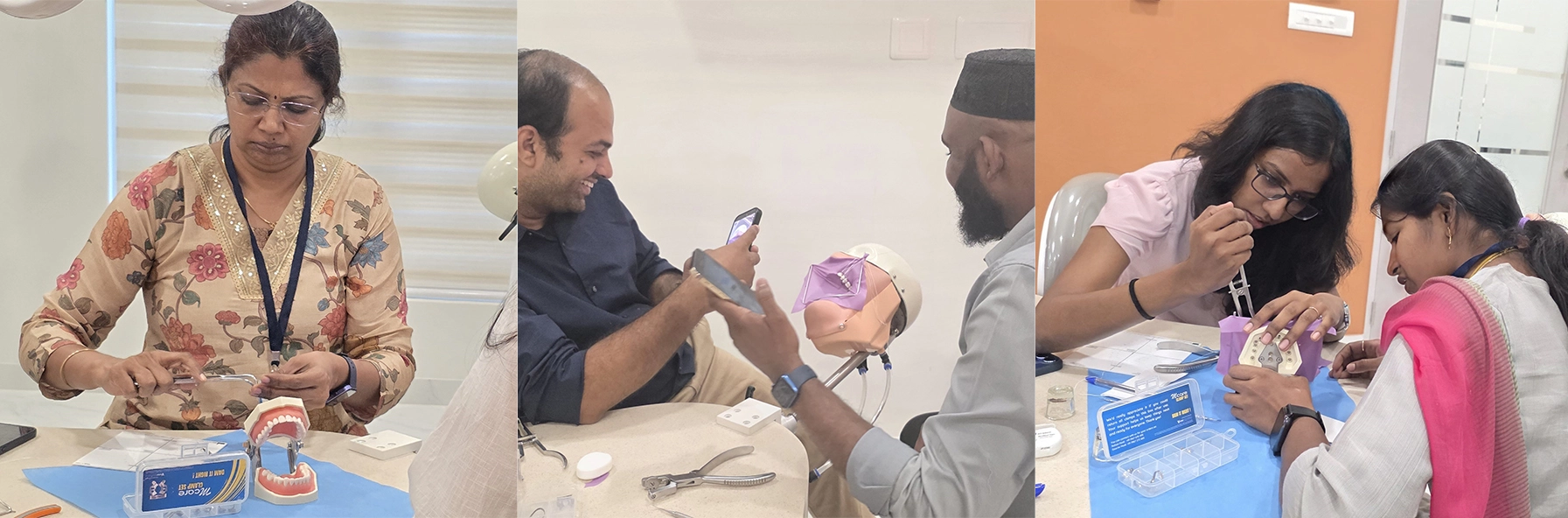
Placement technique is the second lesson. The wing technique, the wingless technique, the bow technique for difficult posterior teeth, and the split dam approach for anterior cases. The course walks through each placement protocol step by step, with demonstrations, and then puts each participant through repeated hands-on placement on phantom heads until the technique is reflexive.
Special situations are the third lesson. Deep subgingival margins, where the dam needs to be stabilised with floss ligatures or a B4 clamp. Fractured teeth where the clamp anchoring is unreliable. Multiple-tooth isolation for quadrant dentistry. Difficult anterior cases. Patients who have had the dam attempted before, found it claustrophobic, and need a specific communication script before the second attempt.
By the end of day one, every participant should be able to place a rubber dam on any tooth in the mouth, in under five minutes, with margins that remain dry through a full restorative procedure.
The Composite Curriculum in Detail
The composite teaching is built around the principle that the restoration is determined long before the first layer of material is placed. Cavity design, matrix selection, bonding protocol, and layering technique together account for almost all the variation in restorative outcome. Polish and finishing matter, but they cannot rescue a poorly bonded, poorly contoured restoration.
Cavity design covers the minimally invasive adhesive philosophy. The conservative removal of carious dentine. The preservation of enamel margins wherever possible. The bevelling principles for anterior restorations. The cavity floor management in deep cavities, including selective caries removal where indicated.
Matrix selection covers the choice between sectional matrices and circumferential bands. The sectional matrix systems available in the Indian market and the specific technique for each. The wedging strategy, including soft wedges, plastic wedges, and the Bioclear matrix system for situations that demand a different approach.
Bonding protocols cover the contemporary simplified workflow as well as the multi-step total etch alternative. Surface treatment of enamel and dentine. The handling characteristics of different universal adhesives. The light-curing protocols that maximise polymerisation while minimising shrinkage stress.
Layering technique covers both posterior and anterior composites. Posterior layering using horizontal increments, oblique layering, and the bulk-fill workflow with newer materials. Anterior layering using dentine and enamel shades, the placement of opacious bodies and translucent incisal edges, the management of the proximal aesthetic contact, and the recreation of natural surface texture.
Finishing and polishing cover the bur sequence, the abrasive disc systems, the rubber polishing points, and the high-gloss diamond paste finish that takes a competent restoration into the category of work that disappears into the natural tooth.
The Hands-On Component
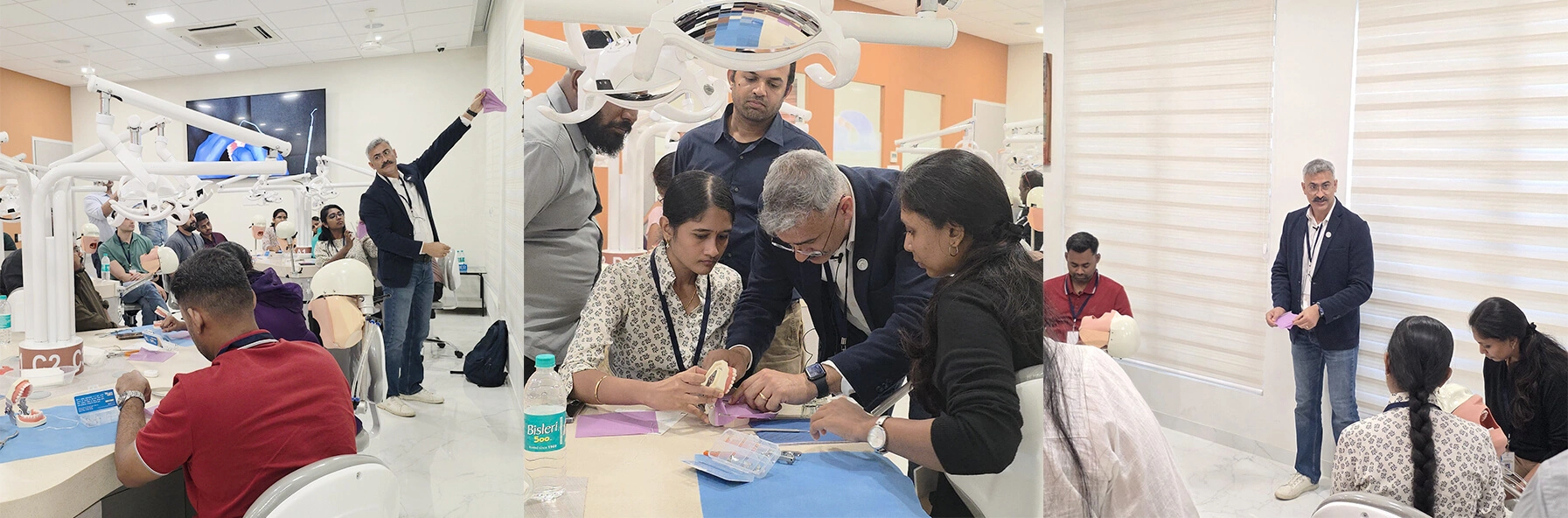
The simulation lab at Acharya Foundation is equipped with phantom heads, typodonts, complete instrumentation, and the full range of bonding and composite materials needed to work through the exercises. Every participant has their own workstation. The faculty walks the floor through every exercise, giving direct feedback on technique.
The exercises mirror the lecture content. Rubber dam placement in multiple scenarios. Class II composite restorations with sectional matrix systems. Anterior direct veneers and Class IV build-ups. The exercises are designed to be repeatable, so that participants can practise the same technique multiple times across the three days and feel the technique become reflexive.
The course also covers practical material selection. Different composite brands behave differently, and the course discusses the handling characteristics of the most commonly used systems in the Indian market, giving participants a vendor-neutral overview of what to expect from each.
Who Should Attend
This is a foundational course built for working clinicians. The ideal participant is a general dentist who places direct composites regularly and wants to systematically upgrade their workflow, with rubber dam isolation as the cornerstone of that upgrade. The course assumes basic restorative experience and familiarity with adhesive dentistry. It does not assume previous proficiency with rubber dams, and is in fact designed for clinicians who have been avoiding it because their earlier attempts were frustrating.
It is also a useful course for recent BDS graduates in their first or second year of practice, who often find that the gap between what they were taught at college and what their patients need is largest in restorative dentistry. The hands-on component gives early-career dentists the chance to build technique under direct supervision in a way that is rarely available after graduation.
Specialists from other disciplines have also attended past batches. Endodontists who want to refine their rubber dam workflow for complex isolation scenarios. Prosthodontists who want to upgrade their direct composite skills for the cases that do not need an indirect restoration. The classroom mix benefits from this diversity, and the discussion regularly surfaces clinical scenarios that participants would not encounter individually.
The Value of the One-Day Rubber Dam Course
For dentists who specifically want to focus on isolation technique without the broader composite curriculum, Dr. Vishal Gupta also teaches a standalone one-day Rubber Dam hands-on course at Acharya Foundation. The course is intensive, focused, and built around getting every participant comfortable with rubber dam placement across the full range of clinical scenarios in a single day.
The one-day course is a good starting point for clinicians who are unsure about committing to the full three-day intensive, or for those who already have a strong composite practice and want to add the isolation skill specifically. Many participants attend the one-day course first, find the value clear, and return for the three-day course later in the year.
The Investment
The three-day Direct Composite and Rubber Dam course has run in past editions as a sponsored programme with no participant fee, including the October 2025 batch which filled all twenty-five seats. The pricing for future editions is updated on the course page as the calendar is published.
The financial return on a structured rubber dam and composite skill is substantial and shows up across the entire restorative workflow, not just in the composites themselves. Reduced post-operative sensitivity reduces follow-up appointments. Better isolation improves crown cementation outcomes, endodontic isolation, and adhesive protocols for veneers and inlays. Better composites last longer, which reduces the chair time spent on re-restoration and improves practice reputation. The skill compounds across every restorative procedure the clinician performs.
For delegates travelling to Chennai, the foundation can assist with hotel recommendations close to the Nungambakkam campus.
How to Register
Upcoming dates for both the three-day Direct Composite and Rubber Dam intensive and the one-day Rubber Dam standalone course are listed on the Acharya Foundation Upcoming Courses page at acharya-foundation.com/upcoming-courses. The course detail pages are available at acharya-foundation.com/course/direct-composite-rubber-dam-hands-on-course and acharya-foundation.com/course/rubber-dam-1-day-hands-on-course.
Past cohorts have filled before the published deadlines. Early registration is recommended. The booking page at acharya-foundation.com/booking accepts enquiries directly, and the team responds within a working day. The full course brochure is downloadable from the course page.
For general queries, the foundation can be reached at acharya@acharyadental.com or on +91-44-35111100. The campus is at 7 Thirumurthy Nagar, 6th Street, Nungambakkam, Chennai 600034. Prospective participants are welcome to visit the simulation lab before committing.
A Final Thought
There is no aesthetic dentistry, no implant prosthetics, no endodontic success, and no long-term restorative result that does not begin with isolation and the quiet craft of placing a direct composite well. Every other procedure in the practice depends on the clinician's ability to build a dry, controlled, well-managed working field, and to place an adhesive restoration that survives in the mouth for a decade or more.
This is the course that anchors that ability for the rest of a clinical career. Three days of focused hands-on training in Chennai, with one of India's most respected restorative educators, on equipment built for serious practice. We hope to see you in a future batch.
Acharya Foundation | Advanced Education, Simplified
7 Thirumurthy Nagar, 6th Street, Nungambakkam, Chennai 600034
[acharya-foundation.com](https://www.acharya-foundation.com) | acharya@acharyadental.com | +91-44-35111100